I Been Here Begore I Been Hete Again
| Exist Here Now | ||||
|---|---|---|---|---|
 | ||||
| Studio album by Oasis | ||||
| Released | 21 Baronial 1997 (1997-08-21) | |||
| Recorded | November 1996 – April 1997 | |||
| Studio | Abbey Road, AIR, Orinoco and Primary Rock in London; Ridge Farm, Surrey | |||
| Genre | Britpop | |||
| Length | 71:33 | |||
| Characterization | Creation | |||
| Producer |
| |||
| Haven chronology | ||||
| ||||
| Singles from Be Here Now | ||||
| ||||
Be Here Now is the third studio album past English language rock band Haven, released on 21 Baronial 1997 by Cosmos Records. The anthology was recorded at multiple recording studios in London, including Abbey Road Studios, also every bit Ridge Farm Studio in Surrey. Although almost tracks retain the anthemic quality of previous releases, the songs on Exist Here Now are longer and contain many guitar overdubs. Noel Gallagher said this was washed to brand the anthology sound as "jumbo" equally possible. The album comprehend features a shot of the band members at Stocks House in Hertfordshire.
Following the worldwide success of their showtime 2 albums, Definitely Mayhap (1994) and (What's the Story) Morning Glory? (1995), the album was highly anticipated. Oasis' management company, Ignition, were aware of the dangers of overexposure, and earlier release sought to control media admission to the anthology. The campaign included limiting pre-release radio airplay and forcing journalists to sign gag orders. The tactics alienated the press and many industry personnel connected with the band and fueled large-scale speculation and publicity within the British music scene.
Preceded by the lead unmarried "D'You lot Know What I Mean?", Be Here Now was an instant commercial success, selling faster than its two predecessors (it became the fastest-selling album in British chart history) and topping the albums chart in 15 countries. It was the biggest selling album of 1997 in the Britain, with 1.47 million units sold that year. As of 2016, the album has sold viii 1000000 copies worldwide. It has been certified 6× Platinum in the U.k. and Platinum in the US, being Haven' third and terminal Platinum anthology in the state.
According to co-producer Owen Morris, the recording sessions were marred by arguments between the band members and drug corruption, and the band's only motivations were commercial.[2] While initial reception for Be Here At present was overwhelmingly positive, retrospective reviews of the album accept been more negative, with many calling it bloated and over-produced. The band members have had differing views of the album, with Noel severely criticising it and Liam Gallagher highly praising information technology and fifty-fifty declaring it equally his favourite Oasis album in a 2017 interview. Critic Jon Roughshod would later on pinpoint the album as the cease of the Britpop movement. In 2016, the album was reissued with bonus tracks, including a new remix of "D'You Know What I Mean?".
Background [edit]
By the summer of 1996, Oasis were widely considered, according to guitarist Noel Gallagher, "the biggest band in the world ... bigger than, dare I say it, fucking God."[3] The commercial success of their previous two albums had resulted in media frenzy in danger of leading to a backlash.[4]
Earlier that twelvemonth, Oasis members holidayed with Johnny Depp and Kate Moss in Mick Jagger's villa in Mustique. During their terminal stay on the island, Noel wrote the bulk of the songs that would make up Be Hither At present.[5] He had suffered from author'due south block during the previous wintertime, and said he wrote just a single guitar riff in the six months following the release of (What'south the Story) Morning Glory?. Eventually, he disciplined himself to a routine of songwriting where he would go "into this room in the morning, come out for lunch, go back in, come out for dinner, get back in, then go to bed."[6] Noel said "virtually of the songs were written earlier I even got a tape deal, I went away and wrote the lyrics in about 2 weeks."[7] Haven producer Owen Morris joined Gallagher afterward with a TASCAM eight-track recorder, and they recorded demos with a drum machine and a keyboard.[viii]

Haven performing at Knebworth in 1996, where they played to crowds of over 250,000 people.
In August 1996, Haven performed two concerts before crowds of 250,000 at Knebworth Business firm, Hertfordshire; more than 2,500,000 fans had practical for tickets.[9] The dates were to be the zenith of Oasis's popularity, and both the music printing and the ring realised it would not exist possible for the band to equal the event.[three] By this fourth dimension, infighting had broken out in the ring. On 23 August 1996, singer Liam Gallagher refused to sing for an MTV Unplugged performance at London's Royal Festival Hall, pleading a sore throat.[10] He attended the concert and heckled Noel from the upper balcony. Iv days later, Liam declined to participate in the first leg of an American tour, lament that he needed to buy a business firm with his and then-girlfriend Patsy Kensit. He rejoined the band a few days after for a key concert at the MTV Video Music Awards in New York, but intentionally sang off-key and spat beer and saliva during the operation.[11]
Amongst much internal bickering, the tour continued to Charlotte, Northward Carolina, where Noel finally lost his patience with Liam and announced he was leaving the band. He said later: "If the truth be known, I didn't desire to exist in that location anyway. I wasn't prepared to be in the ring if people were beingness like that to each other."[three] Noel rejoined Oasis a few weeks afterwards, but the band'due south management and handlers were worried. With an album's worth of songs already demoed, the Gallaghers felt that they should record equally soon every bit possible. Their managing director, Marcus Russell, said in 2007 that "in retrospect, nosotros went in the studio also quickly. The smart move would have been to take the residuum of the yr off. But at the time information technology seemed like the right affair to do. If you're a band and you've got a dozen songs you call back are great, why not go and practice it."[3]
"I have to say that I cocked upwardly, and I think Noel did also, in not using and referencing the demos more than on the actual album sessions. [...] Be Hither At present would have been a far better record had we been able to use Noel's guitars and bass and percussion from the Mustique demos. We could've just overdubbed the drums and Liam's singing, and Bonehead's guitar and that would have been a great album. So I very sadly admit that I mucked upwardly royally there."
– Owen Morris, discussing the Mustique demos[viii]
In 2006, Noel agreed that the band should take separated for a year or two instead of going into the studio.[12] However, Morris later wrote: "Information technology was a mistake on everyone's part, direction very much included, that we didn't record Be Hither Now in the summertime of 1996. Information technology would have been a much unlike album: happy probably."[eight] He described the Mustique demos every bit "the terminal good recordings I did with Noel", and said his relationship soured following the Knebworth concert.[eight]
Recording and production [edit]
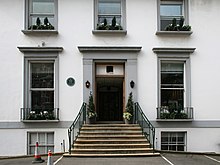
Recording began on 7 October 1996 at EMI's Abbey Route Studios in London.[13] Morris described the first week equally "fucking awful", and suggested to Noel that they abandon the session: "He just shrugged and said information technology would exist all right. So on we went." Liam was under heavy tabloid focus at the time, and on nine November 1996 was arrested and cautioned for cocaine possession at the Q Awards. A media frenzy ensued, and the band's management made the decision to move to a studio less readily accessible to paparazzi. Lord's day showbiz editor Dominic Mohan recalled: "We had quite a few Haven contacts on the payroll. I don't know whether whatever were drug dealers, simply there was always a few dodgy characters about."[3]
Oasis'due south official photographer Jill Furmanovsky felt the media's focus, and was preyed upon by tabloid journalists living in the flat upstairs from her: "They thought I had the band hiding in my flat." In paranoia, Oasis cut themselves off from their wider circle. According to Johnny Hopkins, the publicist of Haven's label Creation Records, "People were being edged out of the circle around Oasis. People who knew them before they were famous rather than because they were famous." Hopkins likened the situation to a medieval court, complete with kings, courtiers and jesters, and said: "One time you're in that situation you lose sight of reality."[three]
On 11 Nov 1996, Oasis relocated to the rural Ridge Farm Studio in Surrey. Though they reconvened with more than free energy, the early recordings were compromised by the drug intake of all involved. Morris recalled that "in the first week, someone tried to score an ounce of weed, but instead got an ounce of cocaine. Which kind of summed it up."[3] Noel was not nowadays during any of Liam'due south song track recordings. Morris thought that the new material was weak, but when he voiced his opinion to Noel he was cutting down: "[Then] I just carried on shovelling drugs up my nose." Morris had initially wanted to just transfer the Mustique demo recordings and overdub drums, vocals, and rhythm guitar, but the 8-track mixer he had employed required him to bounce tracks for overdubs, leaving him unable to remove the drum machine from the recordings.[viii]
Noel, wanting to make the anthology as dumbo and "jumbo" feeling as possible, layered multiple guitar tracks on several songs. In many instances he dubbed ten channels with identical guitar parts, in an endeavor to create a sonic volume.[3] Creation'due south owner Alan McGee visited the studio during the mixing phase; he said, "I used to go down to the studio, and there was so much cocaine getting done at that point ... Owen was out of command, and he was the one in charge of it. The music was just fucking loud."[5] Morris responded: "Alan McGee was the head of the record company. Why didn't he practise something well-nigh the 'out of control' record producer"? Obviously, the one not in command was the head of the record company."[8] He said that he and the band had been dealing with personal difficulties the day and nighttime before McGee visited the studio.[viii]
Songs [edit]
As with Oasis' previous two albums, the songs on Be Here At present are generally anthemic. The structures are traditional,[14] and largely follow the typical verse – chorus – verse – chorus – middle 8 – chorus format of guitar-based stone music. Reviewing for Nude as the News, Jonathan Cohen noted that the anthology is "virtually interchangeable with 1994'south Definitely Perchance or its blockbuster sequel, (What'southward the Story) Morning Glory?",[15] while Noel had previously remarked that he would make three albums in this generic style.[14] Yet the songs on Be Hither Now differ in that they are longer than previous releases; an extended coda brings "D'You Know What I Mean?" to nigh 8 minutes, while "All Around the World" contains three key changes[xv] and lasts for a full nine minutes.[14] When "D'You Know What I Mean?" was released as the album's first single, Noel Gallagher expected to be asked to reduce the length of the song by two minutes. However, nobody had the courage.[xvi]
The tracks are more layered and intricate than before, and each contains multiple guitar overdubs.[17] While Morris had previously stripped away layers of overdubs on the band'due south debut Definitely Perhaps, during the production of Be Here At present he "seemed to gleefully encourage" such excess; "My Big Rima oris" has an estimated thirty tracks of guitar overdubbed onto the vocal.[18] A Rolling Stone review described the guitar lines as equanimous of "elementary riffs."[nineteen]
In that location was some experimentation: "D'You Know What I Hateful?" contains a slowed down loop from N.Westward.A'southward "Directly Outta Compton",[xx] while "Magic Pie" features psychedelically bundled vocal harmonies and a mellotron. According to Noel, "All I did was run my elbows beyond the keys and this mad jazz came out and everyone laughed."[21] The album's product is dominated by superlative-cease loftier frequency tones, and co-ordinate to Uncut 's Paul Lester, its use of treble is reminiscent of both late 1980s Creation Records bands such as My Bloody Valentine, and the Stooges' famously under-produced Raw Power (1973).[twenty] Co-ordinate to Bonehead himself, the album had been mastered so loudly it necessitated a release on double vinyl.[22]
The vocal melodies continue Noel'southward preference for "massed-rank sing-alongs", although Paul Du Noyer concedes that not all are of the "pub-trashing idiot kind" of previous releases.[14] At the time of release, Q 's Phil Sutcliffe summarised the lyrics of Be Here Now as a mixture of "hookline optimism, a swarm of Beatles and other '60s references, a gruff love song to Million, and further tangled expressions of his inability/unwillingness to limited profound emotions."[half-dozen] David Fricke found the numerous Beatles references, including the line "the fool on the hill and I experience fine" from "D'You lot Know What I Mean?" and "Sing a song for me, one from Let It Exist" on the title track every bit lazy songwriting from Noel.[nineteen] Reviewers have also found Beatles references in the music, on tracks such as "All Around the World", which has been compared to the sing-along qualities of "Hey Jude" and "All You Need Is Honey".[23]
The lyrics were elsewhere described as "[running] the gamut from insightful to insipid",[xv] although Du Noyer admitted that Noel is "[to go by his lyrics] something of a closet philosopher ... and ofttimes romantic to the point of big girl'southward blousedom." While the tracks "Don't Go Away" and "The Girl in the Muddy Shirt" were described equally unabashedly sentimental, Du Noyer went on to observe that "there is compassion and sensitivity in these tracks that is not the piece of work of oafs." Du Noyer conceded that Noel frequently tied himself up in "catholic knots", but had "written words that sound simple and truthful, and are therefore poetic without trying to be."[fourteen] Lester read vocal titles such as "Stand by Me" and "Don't Go Away" as a series of demands, both to members of his private life and his public audience.[20]
Du Noyer praised Liam'due south song contributions and described his "Northern punk whine" as "the about distinctive individual style of our time."[14] Lester alluded to Liam equally Noel'southward "mouthpiece", although he qualified that Liam is the "phonation of every working-class boy with half a yen to intermission out and make it big."[20]
Album cover [edit]
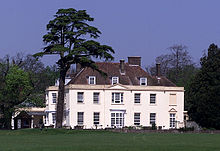
Stocks House, the 18th-century mansion used as the location for the cover photo
The comprehend image was shot in April 1997 at Stocks House in Hertfordshire, the quondam domicile of Victor Lownes, head of the Playboy Clubs in the Great britain until 1981. It shows the ring standing by the swimming pool exterior the hotel, surrounded by various props. For the photo shoot, a white 1972 Rolls-Royce Silver Shadow was lowered into the swimming pool and half submerged in the h2o.[24]
Photographer Michael Spencer Johns said the original concept involved shooting each band member in various locations around the world, but when the cost proved prohibitive, the shoot was relocated to Stocks House. Spencer remarked that the shoot "degenerated into anarchy", adding that "by 8 pm, anybody was in the bar, there were schoolkids all over the ready, and the lighting crew couldn't showtime the generator. It was Alice in Wonderland meets Apocalypse At present." Critics accept tried to read into the selection of the embrace props, but Johns said Gallagher but selected items from the BBC props shop he idea would wait skillful in the flick. Two props considered were an inflatable globe (intended as a homage to the sleeve of Definitely Mayhap) and the Rolls Royce, suggested past Arthurs.[25]
Jones has said that the partially submerged Rolls Royce was in reference to Keith Moon'due south oft-fabled sinking of a Lincoln Continental into a hotel swimming puddle in 1967.[26] [27] [28] The release date in each region was commemorated on the calendar pictured on the sleeve; Harris said the dating "[encouraged] fans to believe that to purchase a copy on the day information technology appeared was to participate in some kind of historical event."[29] The anthology cover also spurred controversy from a legal viewpoint. In the case of Creation Records Ltd v News Group Newspapers Ltd, the court decided that the collection of objects brought together for the album cover was bereft in creating an artwork that could be protected by copyright.[30]
Release [edit]
Promotion [edit]
When Alan McGee, Creation'south publicist Johnny Hopkins, and marketing executive Emma Greengrass starting time heard Exist Here Now at Noel Gallagher's house, each had their doubts about its creative value, but kept their doubts to themselves. One Creation employee recalled "a lot of nodding of heads, a lot of slapping of backs."[31] McGee later admitted to having stiff misgivings at offset: "I heard it in the studio and I retrieve saying 'We'll only sell 7 million copies' ... I idea it was too confrontational."[31] However, in an interview with the music press a few days later he predicted the album would sell twenty million copies. McGee'south hyperbole alarmed both Haven and their management company Ignition, and both immediately excluded him from involvement in the release campaign. Ignition'southward strategy from that signal on centred on an effort to suppress all publicity, and withheld access to both music and information from anybody not directly involved with the album'south release. Fearful of the dangers of over-hype and bootlegging, their aim was to present the tape as a "regular, everyday drove of tunes." To this end they planned a small marketing budget, to exist spent on subdued promotional activities such every bit street posters and music press adverts, while fugitive mainstream instruments such as billboard and Idiot box advertising. According to Greengrass "We want to keep it low key. Nosotros want to keep control of the whole mad thing."[32]
Yet, the extent that Ignition were willing to get to control access to the album generated more than hype than could ordinarily accept been expected, and served to alienate members of both the print and circulate media, likewise as virtually Cosmos staff members. When "D'You Know What I Mean?" was planned as the commencement single, Ignition decided on a tardily release to radio and then as to avoid too much advance exposure. However, iii stations broke the embargo, and Ignition panicked. According to Greengrass: "we'd been in these bloody bunker meetings for six months or something, and our plot was blown. 'Shit, it'southward a nightmare'."[33] BBC Radio 1 received a CD containing 3 songs x days earlier the album'southward release, on condition that disc jockey Steve Lamacq talked over the tracks to prevent illegal copies beingness fabricated by listeners. The 24-hour interval after Lamacq previewed the anthology on his testify, he received a phone call from Ignition informing him that he would not be able to preview farther tracks because he didn't speak enough over the songs. Lamacq said, "I had to become on the air the next dark and say, 'Sad, but we're not getting whatever more tracks.' Information technology was just absurd."[34] According to Cosmos's head of marketing John Andrews, "[The campaign] made people despise Oasis inside Creation. You had this Haven army camp that was like 'I'm sorry, you're not allowed come into the function between the following hours. Yous're not immune mention the word Oasis.' It was like a fascist state."[33] One employee recalled an incident "when somebody came round to check our phones because they thought The Sun had tapped them."[33]
When Hopkins began to circulate cassette copies of the anthology to the music press a few weeks after, he required that each journalist sign a contract containing a clause requiring that the cassette recipient, co-ordinate to Select journalist Mark Perry, "not discuss the anthology with anyone—including your partner at home. Information technology basically said don't talk to your girlfriend virtually it when you're at home in bed."[35] Reflecting in 1999, Greengrass admitted: "In hindsight a lot of the things nosotros did were ridiculous. We sit in [Haven] meetings today and we're similar 'It's on the Internet. Information technology's in Camden Market. Whatever'. I retrieve we've learned our lesson."[36] According to Perry: "It seemed, particularly once you heard the album, that this was cocaine grandeur of just the most ludicrous degree. I recollect listening to "All Effectually the World" and laughing—actually quite pleasurably—because information technology seemed and then ridiculous. You just thought: Christ, in that location is so much coke beingness done here."[35]
Commercial performance [edit]
Be Here Now was released in the UK on 21 August 1997. The release date had been brought forward out of Ignition's fearfulness that import copies of the album from the United States would make it in Great britain before the street date.[29] Worrying that Goggle box news cameras would interview queuing fans at a traditional midnight opening session, Ignition forced retailers to sign contracts pledging not to sell the record earlier than 8:00am.[33] However, the cameras arrived regardless, simply in time to record the initially slow merchandise. It was non until lunch time that sales picked upwards. By the end of the first day of release, Be Here Now sold over 424,000 units and past the terminate of business on Sat that week sales had reached 663,389, making it based on first seven days sales, the fastest-selling album in British history.[37] [38] The album became their highest charting release in the US by debuting at number ii on the Billboard 200 chart. However, its offset calendar week sales of 152,000—below expected sales of 400,000 copies—were considered a disappointment.[39]
Exist Here Now was the biggest selling anthology of 1997 in the United kingdom, with 1.47 million units sold that year.[forty] By the end of 1997, Be Hither Now had sold 8 one thousand thousand units worldwide. Yet, nearly sales came from the first two weeks of release, and in one case the album was released to U.k. radio stations the turnover tapered off. Buyers realised that the album was non another (What's the Story) Morning Celebrity?, and by 1999, Tune Maker reported that it was the anthology most sold to second-manus record stores.[36] It has been certified 7× Platinum in the UK and Platinum in the U.s., beingness Oasis' 3rd and final Platinum album in the country. Every bit of 2016, the album had sold over eight one thousand thousand copies worldwide.[41] [42] Four of the album's 12 tracks were released as singles: "D'Y'all Know What I Mean?", "Stand Past Me", "All Around the Globe" and "Don't Go Away".[43] In 2016, post-obit the anthology's reissue and the release of the documentary Oasis: Supersonic, the album topped the UK Vinyl Albums Nautical chart, xix years after its original release.[44]
Critical reception [edit]
| Original release | |
|---|---|
| Review scores | |
| Source | Rating |
| Chicago Sun-Times |  [45] [45] |
| Amusement Weekly | B[46] |
| Los Angeles Times |  [47] [47] |
| NME | 8/10[48] |
| Pitchfork | vii.9/10[49] |
| Q | [50] |
| Rolling Stone |  [nineteen] [nineteen] |
| Spin | 6/10[51] |
Contemporaneous reviews of Exist Here At present were, in John Harris's words, unanimous with "truly amazing praise". According to Harris, "To notice an album that had attracted gushing notices in such profusion, one had to go dorsum 30 years, to the release of Sgt. Pepper'southward Alone Hearts Club Ring."[52] While Q described the album as "cocaine ready to music", nigh early on reviews praised the record'due south length, volume and ambition, including Charles Shaar Murray, who called it the "Oasis Globe Domination Album" in MOJO.[23] David Fricke of Rolling Stone complimented the vocal formula throughout the album, writing that it "pays off". However, as a whole, he felt the anthology was "music built for impact, not explanation".[19] Dele Fadele of Vox describes it as "a veritable rock'n'roll monsoon of an album; a giant jigsaw puzzle, an elemental force, a monster that cannot and will not exist independent."[53]
Reviews in the British music press for (What's the Story) Morning time Glory? had been mostly negative. When it went on to become, in the words of Select editor Alexis Petridis, "this huge kind of Zeitgeist defining record" the music press was "baffled".[54] Realising they had got information technology wrong the last time, Petridis believes the initial glowing reviews were a concession to public opinion.[54] In America, reviews were equally as positive. Reviewing for the Chicago Sun-Times on release, Jae-Ha Kim considered the album as good as its two predecessors, writing: "The 12 tracks on Exist Hither Now aren't as immediately accessible as Haven' earlier hits "Wonderwall" or "Alive Forever". But the pop songs are mesmerizing in their intense delivery and clean execution."[45] Elysa Gardner offered similar in the Los Angeles Times, finding that with Exist Hither Now, the ring grew more than ambitious and succeeded without losing ground, although Gardner noted the "taut pop craftsmanship" that distinguished the band's two predecessors was "less prominent".[47]
Withal, the album did receive some mixed reviews on release. In Entertainment Weekly, David Browne stated: "Much of the album is a messy, mucky keg o' audio that constantly threatens to spill over and drown Noel's innately melodic songs." He further criticised the overtly-cluttered mix and overlong songs. Nevertheless, he concluded: "They audio more ferocious and confident than ever, nevertheless less intimate, more distanced."[46] Similarly, Simon Williams called it "one of the daftest records ever fabricated" in NME.[48] Likewise, Chris Norris criticised the lyrical content in Spin magazine, calling most of the lyrics on the tape "meaningless".[51] Ryan Schreiber of Pitchfork compared the record to its two predecessors favourably, finding that instead of "unforgettable three- to- four minute pop slices", there are now "vi- to- ten infinitesimal long epics."[49]
Retrospective appraisal [edit]
| Retrospective reviews | |
|---|---|
| Aggregate scores | |
| Source | Rating |
| Metacritic | 57/100[55] (2016 reissue) |
| Review scores | |
| Source | Rating |
| AllMusic | [56] |
| Clash | viii/10[57] |
| Drowned in Audio | five/10[58] |
| Encyclopedia of Popular Music | [59] |
| Pitchfork | 5.3/ten[sixty] |
| The Rolling Stone Album Guide | [61] |
| Spin | [62] |
Retrospectively, reception to Be Here Now has been more negative, with many calling it bloated and over-produced. Reviewing in 2002, Stephen Thompson of The A.Five. Social club felt that although there were good tracks present, naming "My Big Rima oris", "Don't Get Away" and "Stand By Me", the bulk suffered from "cumbersome overlength", feeling that the ring's try to make a "grand, career-defining statement" backfired.[4] In The Rolling Stone Album Guide (2004), Rob Sheffield described the record as "a concept album about how long all the songs were", comparing it to Elton John'due south Helm Fantastic and the Brown Clay Cowboy (1975). Although he offered praise to the title rails and "It's Getting Better (Human being!!)", he considered the album to exist the work of a songwriter who has "plough[ed] his encephalon [in]to cocaine crispies".[61] In a more positive review, Stephen Thomas Erlewine of AllMusic calls Exist Here Now a "triumphant" record that "steamrolls over any criticism", praising Liam's vocal performances as his finest up to that point, also every bit the songs as "intensely enjoyable" and "impossibly tricky". However, he felt that Noel'southward songwriting wasn't innovative compared to its predecessors.[56] In 2020, Luke The netherlands of The Guardian described the album as a "flawed masterpiece."[63]
The anthology'southward 2016 reissue attracted a number of reviews, with almost continuing to criticise the anthology's production and song lengths. Laura Snapes of Pitchfork calls Be Here Now "i of the nigh agonizing listening experiences in pop music", amplified by the "swollen and indulgent" remaster. Snapes further panned Noel'due south conclusion to only remix "D'You Know What I Mean?", final that in that location was no point in reissuing the album if its creators didn't intendance enough. She ultimately states, "this turgid collection is the ultimate expression of Exist Hither Now: as bloated and indulgent as the record itself, the music a secondary business organisation to the product's status".[60] In Drowned in Audio, Andrzej Lukowski felt that when compared to the band's earlier work, Exist Here Now lacked "aspirational stone 'n' ringlet swagger" as well a few tracks. Lukowski also agreed that a complete remix of the album would have been beneficial, considering "D'Y'all Know What I Mean?" needed it "the least".[58] In Clash mag, Clarke Geddes was more positive, agreeing that although the album was bloated and over-produced, it however offered highlights, naming "I Promise, I Call up, I Know". He also positively appraised the bonus tracks in the box set, assertive fans will be satisfied with the extra material.[57]
Legacy [edit]
"It's the sound of ... a bunch of guys, on coke, in the studio, not giving a fuck. At that place's no bass to information technology at all; I don't know what happened to that ... And all the songs are really long and all the lyrics are shit and for every millisecond Liam is non saying a word, there's a fuckin' guitar riff in there in a Wayne's World stylie".
– Noel Gallagher reflecting on Be Here Now [64]
In the 2003 John Dower-directed documentary Live Forever: The Ascent and Fall of Brit Pop, music critic Jon Savage pinpointed Be Hither Now as the moment where the Britpop movement ended. Savage said that while the album "isn't the great disaster that everybody says", he noted that "[i]t was supposed to exist the big, large triumphal record" of the menstruation.[64] Q expressed similar sentiments, writing, "And so colossally did Be Hither Now fall curt of expectations that it killed Britpop and ushered in an era of more ambitious, less overblown music."[3] Irish Times announcer Brian Boyd wrote: "Swollen and over-heated (much like the band themselves at the time), the album has all that dreadful braggadocio that is and so characteristic of a cocaine user."[65] Reflecting in 2007, Garry Mulholland said: "The fact that nothing could have lived up to the fevered expectations that surrounded its release doesn't change the facts. The tertiary Oasis album is a loud, lumbering noise signifying nada."[three] When reviewing in 2016, Lukowski wrote that although Oasis as a ring would continue, Oasis as a legend died with Be Here Now. He further states that while other Britpop bands such as Pulp and Blur moved on from the genre, Oasis continued attempting to revisit the success of their offset two albums, finer becoming a "nostalgia act" afterward 1997.[58]
The Gallagher brothers hold differing opinions about the album. In July 1997, Noel was describing the production as "banal" and some tracks every bit "fucking shit".[iii] He later said: "Simply because you sell lots of records, it doesn't hateful to say you lot're any good. Look at Phil Collins."[66] In Live Forever: The Rise and Fall of Brit Pop, he dismissed the album, and said that drugs and the band's indifference during recording led to the album having faults. In the same documentary, Liam dedicated the record, and said that "at that fourth dimension nosotros idea it was fucking great, and I yet think it'southward great. It simply wasn't Morn Glory."[64] In 2006, Liam said of Noel, "If he didn't similar the record that much, he shouldn't have put the fucking record out in the first place ... I don't know what's up with him but it's a elevation record, human, and I'thou proud of information technology—it's just a trivial bit long."[67] In 2018, the BBC included information technology in their list of "the acclaimed albums that nobody listens to any more."[68] Noel has observed that many Haven fans however concur the album in high regard, as do prominent musicians such as Marilyn Manson.[69] In 2017, Liam ranked the album as his favourite release past Oasis.[70]
Track listing [edit]
All tracks are written past Noel Gallagher.
| No. | Title | Length |
|---|---|---|
| one. | "D'Y'all Know What I Mean?" | vii:42 |
| 2. | "My Large Oral fissure" | five:02 |
| 3. | "Magic Pie" | 7:nineteen |
| 4. | "Stand up by Me" | 5:55 |
| five. | "I Hope, I Retrieve, I Know" | iv:23 |
| 6. | "The Girl in the Dirty Shirt" | v:49 |
| 7. | "Fade In-Out" | 6:52 |
| eight. | "Don't Become Away" | 4:48 |
| 9. | "Exist Here At present" | 5:13 |
| x. | "All Effectually the World" | 9:20 |
| 11. | "It's Gettin' Ameliorate (Man!!)" | 7:00 |
| 12. | "All Effectually the World (Reprise)" | 2:10 |
| Total length: | ane:11:33 | |
| No. | Title | Length |
|---|---|---|
| 13. | "All Around the Globe" (Demo) | 5:55 |
| Full length: | 1:17:28 | |
2016 reissue [edit]
As part of a promotional entrada entitled Chasing the Dominicus, the album was re-released on 14 October 2016. The 3-disc deluxe edition includes remastered versions of the anthology and seven B-sides from the anthology'south three UK singles. Bonus content includes demos, the Mustique sessions, live tracks, and a 2016 remix of "D'You Know What I Mean?" Noel Gallagher was supposed to remix the unabridged album but afterward decided against information technology.[71]
| No. | Title | Length |
|---|---|---|
| one. | "Stay Young" | five:08 |
| 2. | "The Fame" | four:36 |
| 3. | "Flashbax" | 5:09 |
| 4. | "(I Got) The Fever" | 5:15 |
| v. | "My Sister Lover" | 5:59 |
| 6. | "Going Nowhere" | 4:42 |
| 7. | "Stand by Me" (Alive at Bonehead'southward Outtake) | 6:03 |
| 8. | "Untitled" (Demo) | 4:38 |
| 9. | "Help!" (Live in L.A.) | 3:45 |
| x. | "Setting Lord's day" (Live Radio Broadcast) | 3:56 |
| 11. | "If We Shadows" (Demo) | 4:53 |
| 12. | "Don't Become Away" (Demo) | 3:43 |
| xiii. | "My Big Mouth" (Live at Knebworth Park, ten August 1996) | v:21 |
| fourteen. | "D'Yous Know What I Hateful?" (NG's 2016 Rethink) | 7:23 |
| Full length: | 1:10:31 | |
| No. | Title | Length |
|---|---|---|
| 1. | "D'You lot Know What I Mean?" (Mustique Demo) | vii:15 |
| two. | "My Big Mouth" (Mustique Demo) | 5:17 |
| iii. | "My Sister Lover" (Mustique Demo) | half dozen:09 |
| iv. | "Stand by Me" (Mustique Demo) | 6:01 |
| v. | "I Promise, I Recollect, I Know" (Mustique Demo) | iv:eleven |
| vi. | "The Girl in the Dingy Shirt" (Mustique Demo) | 5:23 |
| 7. | "Don't Get Abroad" (Mustique Demo) | four:18 |
| viii. | "Trip Inside (Exist Here At present)" (Mustique Demo) | iii:35 |
| ix. | "Fade In-Out" (Mustique Demo) | 6:03 |
| ten. | "Stay Young" (Mustique Demo) | four:56 |
| xi. | "Angel Child" (Mustique Demo) | four:28 |
| 12. | "The Fame" (Mustique Demo) | iv:45 |
| 13. | "All Around the World" (Mustique Demo) | half-dozen:31 |
| xiv. | "Information technology'southward Gettin' Better (Human!!)" (Mustique Demo) | 6:38 |
| Full length: | ane:15:30 | |
Personnel [edit]
Anthology credits per the album'south liner notes.[72]
Charts [edit]
Certifications [edit]
References [edit]
Sources [edit]
- Cavanagh, David. The Creation Records Story: My Magpie Eyes Are Hungry for the Prize. London: Virgin Books, 2000. ISBN 0-7535-0645-9
- Harris, John. Britpop!: Cool Britannia and the Spectacular Demise of English Rock. London: Da Capo Press, 2004. ISBN 0-306-81367-X
Notes [edit]
- ^ "The Official Haven Website – Haven Exist Here Now reissue". oasisinet.com. Archived from the original on 25 August 2015.
- ^ "Be Hither Now – was information technology really and then bad?". "Q" magazine website (q4music.com). EMAP Performance Online. Archived from the original on 29 May 2007. Retrieved 23 June 2007.
The just reason anyone was there was the money. Noel had decided Liam was a shit singer. Liam had decided he hated Noel'southward songs. Then on we went. Massive amounts of drugs. Big fights. Bad vibes. Shit recordings.
- ^ a b c d e f 1000 h i j m Cameron, Keith (June 2007). "Final Orders". Q.
- ^ a b Thompson, Stephen (29 March 2002). "Oasis Be Here Now". The A.5. Club. Archived from the original on 26 September 2007. Retrieved 3 July 2007.
- ^ a b Harris (2004), p. 333.
- ^ a b Sutcliffe, Phil (September 1997). "'Slice of piss!': The Haven Diaries". Q.
- ^ Oasis story – Mono – All Music TV (Italy) – broadcast 26 October 2008
- ^ a b c d e f 1000 Morris, Owen. "The Rising and Fall of Me Recording Oasis". owenmorris.net. Archived from the original on 12 November 2016. Retrieved 24 January 2017.
- ^ "The 90'southward Rock at Knebworth House". Knebworth Estates. 2001. Archived from the original on thirty Nov 2007. Retrieved 23 June 2007.
- ^ "What The Tabloids Said Most Liam Gallagher in 1996". ukcia. Archived from the original on 23 June 2007. Retrieved 13 July 2007.
- ^ Strauss, Neil (6 September 1996). "At the MTV Awards, All the World's a Phase". New York Times. Archived from the original on 27 July 2018. Retrieved 23 June 2007.
- ^ Music, The Guardian (17 Oct 2016). "Noel Gallagher: Nosotros should never have made Exist Here Now and then". The Guardian. Archived from the original on fifteen April 2019. Retrieved 3 Oct 2018.
- ^ "Exist Here Now Archived iv July 2007 at the Wayback Machine". oasisinet.com. Retrieved 23 June 2007.
- ^ a b c d e f Du Noyer, Paul. "Oasis: Be Here Now". Q, October 2000.
- ^ a b c Cohen, Jonathan. "Oasis: Exist Hither Now". Nude As The News. Retrieved 26 June 2007.
- ^ Barfield, Sebastian. "Seven Ages of Rock: What The Globe Is Waiting For". BBC, June 2007.
- ^ Southall, Nick. "Haven: Don't Believe The Truth Archived 15 July 2007 at the Wayback Machine". Stylus Mag, 31 May 2005. Retrieved 30 June 2007.
- ^ Harris (2004), p. 334.
- ^ a b c d Fricke, David (16 December 1997). "Be Here Now". Rolling Stone. Archived from the original on i Nov 2011. Retrieved 26 June 2007.
- ^ a b c d Lester, Paul (September 1997). "Oasis: Exist Hither Now". Uncut. Archived from the original on 24 April 2021. Retrieved 24 April 2021 – via Rock'south Backpages (subscription required).
- ^ Sutcliffe, Phil. "'Of class, me and Liam had a row near it ...'" Q, September 1997.
- ^ Arthurs, Paul (iv April 2020). "The album was mastered and so loud nosotros couldn't fit it on a unmarried vinyl so had to make it a double anthology. Geek fact". @boneheadspage . Retrieved 25 April 2020.
- ^ a b Murray, Charles Shaar (September 1997). "Oasis: Be Here Now". MOJO. Archived from the original on 26 May 2021. Retrieved 24 April 2021 – via Rock'due south Backpages (subscription required).
- ^ Maunder, Rhys (10 December 2021). "Flying Spares X Oasis (Be Here Now)". world wide web.flyingspares.com. Flying Spares. Archived from the original on fifteen April 2022. Retrieved 15 Apr 2022.
- ^ "'It was like Apocalypse At present.' The story behind Exist Here At present's sleeve". Q, June 2007
- ^ Breeze, Joe (4 July 2013). "Frivolous fantasy: How Oasis sank a Rolls-Royce". Classic Commuter. Archived from the original on 12 September 2021. Retrieved 12 September 2021.
- ^ Adejobi, Alicia (26 November 2019). "How Oasis blew £100k on sinking Rolls Royce for iconic Be Here Now album cover". Metro News. Associated Newspapers. Archived from the original on 12 September 2021. Retrieved 12 September 2021.
- ^ Staff writer (23 August 2021). "Keith Moon drove a Rolls Royce into a swimming pool on this twenty-four hour period in 1967. Or did he?". MusicRadar. Time to come Publishing. Archived from the original on 12 September 2021. Retrieved 12 September 2021.
- ^ a b Harris (2004), p. 341.
- ^ "Creation Records Ltd. & Ors 5 News Group Newspapers Ltd [1997] EWHC Ch 370 (25 April 1997)". www.bailii.org. Archived from the original on 7 Feb 2021. Retrieved 2 February 2021.
- ^ a b Cavanagh (2000), p. 518.
- ^ Cavanagh (2000), p. 519.
- ^ a b c d Cavanagh (2000), p. 521.
- ^ Harris (2004), p. 336.
- ^ a b Cavanagh (2000), p. 520.
- ^ a b Cavanagh (2000), p. 523.
- ^ Myers, Justin (21 October 2016). "Haven' Be Hither Now is Number ane on the Official Vinyl Albums Chart". officialcharts.com. Official Charts Company. Archived from the original on 23 October 2016. Retrieved 21 October 2016.
- ^ Ingham, Tim (21 November 2015). "Adele's 25 just went platinum in 24 hours". Music Business Worldwide. Archived from the original on 25 Nov 2015. Retrieved 29 November 2015.
- ^ "Live Forever: Oasis shines in New York while sliding away on the chart". Rolling Stone. 9 Oct 1997. Archived from the original on 4 August 2009. Retrieved 7 June 2007.
- ^ "Official Charts Company". www.officialcharts.com. Archived from the original on xiii September 2016. Retrieved viii March 2018.
- ^ Brandle, Lars (22 July 2016). "Oasis' Record-Great 'Be Here Now' Set for Reissue with New Remix and Rare Demos". Billboard. Archived from the original on 12 June 2020. Retrieved 5 August 2021.
- ^ PDF, Warner Music Grouping. "Oasis" (PDF). Archived (PDF) from the original on six Oct 2013. Retrieved 5 August 2021.
- ^ Hale, Clint (x August 2017). "Looking Dorsum on Oasis' Exist Here Now". Houston Press. Archived from the original on 5 March 2018. Retrieved 8 August 2021.
- ^ "Oasis' Be Here Now is Number 1 on the Official Vinyl Albums Nautical chart". www.officialcharts.com. Archived from the original on 21 March 2019. Retrieved 21 March 2019.
- ^ a b Kim, Jae-Ha (26 August 1997). "'Be Here Now' but great rock 'due north' whorl". Chicago Dominicus-Times. Archived from the original on iii March 2017. Retrieved 14 June 2016.
- ^ a b Browne, David (5 September 1997). "Be Here Now". Entertainment Weekly. Archived from the original on 9 January 2016. Retrieved eight April 2016.
- ^ a b Gardner, Elysa (17 August 1997). "Oasis, 'Exist Here Now,' Epic". Los Angeles Times. Archived from the original on 10 Baronial 2016. Retrieved 14 June 2016.
- ^ a b Williams, Simon (sixteen August 1997). "Oasis – Be Hither Now". NME. Archived from the original on 17 Baronial 2000. Retrieved 14 June 2016.
- ^ a b Schreiber, Ryan. "Oasis: Exist Here Now". Pitchfork. Archived from the original on 2 March 2000. Retrieved 8 April 2016.
- ^ Du Noyer, Paul (September 1997). "Oasis: Be Here At present". Q (132).
- ^ a b Norris, Chris (October 1997). "Oasis: Exist Here At present". Spin. thirteen (7): 136–37. Retrieved 14 June 2016.
- ^ Harris (2004), p. 339.
- ^ Fadele, Dele (September 1997). "Hither's Looking At You, Our Kid: Oasis: Exist Hither Now (Creation)". Vocalisation. Archived from the original on 28 Jan 2021. Retrieved 24 Apr 2021 – via Rock's Backpages (subscription required).
- ^ a b Brennan, Marc A. (2002). "All the same Another Reason to Detest Oasis: Circulation and Branding in the U.k. Music Printing" (PDF). Proceedings Musical In-Between-Ness: The Proceedings of the 8th IASPM Commonwealth of australia – New Zealand Conference. pp. 76–81. Archived from the original (PDF) on iii July 2007.
- ^ "Reviews for Be Here Now [Deluxe Edition – Remastered] by Oasis". Metacritic. Archived from the original on 17 October 2016. Retrieved fourteen October 2016.
- ^ a b Erlewine, Stephen Thomas. "Be Here At present – Oasis". AllMusic. Archived from the original on 21 April 2016. Retrieved 8 Apr 2016.
- ^ a b Geddes, Clarke (12 October 2016). "Haven – Be Hither Now". Clash. Archived from the original on 15 October 2016. Retrieved sixteen Oct 2016.
- ^ a b c Lukowski, Andrzej (5 October 2016). "Album Review: Haven – Be Hither At present (Chasing the Dominicus edition)". Drowned in Sound. Archived from the original on 19 October 2016. Retrieved 16 Oct 2016.
- ^ Larkin, Colin (2011). "Oasis". The Encyclopedia of Popular Music (5th concise ed.). London: Motorcoach Press. ISBN978-0-85712-595-8.
- ^ a b Snapes, Laura (8 October 2016). "Oasis: Be Here Now Album Review". Pichfork. Archived from the original on 12 July 2019. Retrieved 21 Apr 2020.
- ^ a b Sheffield, Rob (2004). "Oasis". In Brackett, Nathan; Hoard, Christian (eds.). The New Rolling Stone Anthology Guide (quaternary ed.). Simon & Schuster. p. 598. ISBN0-7432-0169-8.
- ^ Marchese, David (October 2008). "Discography: Haven". Spin. 24 (10): 76. Archived from the original on 16 June 2020. Retrieved 13 January 2017.
- ^ Holland, Luke (26 September 2020). "'My Daft Punk review hasn't aged so well': Guardian critics on getting information technology wrong". The Guardian. Archived from the original on 8 September 2021. Retrieved 3 January 2021.
- ^ a b c Live Forever: The Ascent and Fall of Brit Pop. Passion Pictures, 2004.
- ^ Boyd, Brian (2007). "The self-importance of being a coke-addled rock'n'roll star". Irish gaelic Times. Archived from the original on 28 November 2021. Retrieved 23 June 2007.
- ^ Roughshod, Marker (24 Nov 2013). "1,000 Number ones: A nautical chart history". BBC News. Archived from the original on 17 November 2016. Retrieved x January 2017.
- ^ ""Liam Gallagher: my Oasis all-time of". NME. 24 November 2006. Archived from the original on 4 March 2016. Retrieved 27 June 2007.
- ^ "7 acclaimed albums that no 1 listens to anymore - BBC Music". www.bbc.co.uk. 9 February 2018. Archived from the original on 25 July 2020. Retrieved 27 December 2020.
- ^ "Noel Gallagher discusses fan reactions to 'Be Here Now'". YouTube. Archived from the original on xiv Nov 2021. Retrieved 12 October 2016.
- ^ Beaumont, Mark (5 Oct 2017). "Liam Gallagher ranks every Oasis, Beady Eye and solo album from worst to best". NME. Archived from the original on 19 July 2020. Retrieved eighteen July 2020.
- ^ Britton, Luke. "Third album was originally released in August 1997". NME. Archived from the original on 20 June 2017. Retrieved 23 Apr 2020.
- ^ Be Hither Now (CD booklet). Oasis. UK: Creation Records. 1997. CRECD 219.
{{cite AV media notes}}: CS1 maint: others in cite AV media (notes) (link) - ^ "Australiancharts.com – Oasis – Be Here Now". Hung Medien. Retrieved 17 February 2021.
- ^ "Austriancharts.at – Oasis – Be Here Now" (in German). Hung Medien. Retrieved 17 February 2021.
- ^ "Ultratop.exist – Oasis – Exist Here At present" (in Dutch). Hung Medien. Retrieved 17 February 2021.
- ^ "Ultratop.exist – Oasis – Be Here Now" (in French). Hung Medien. Retrieved 17 February 2021.
- ^ "Oasis Chart History (Canadian Albums)". Billboard. Retrieved 17 Feb 2021.
- ^ a b "Hits of the Earth". Billboard. 20 September 1997. Retrieved 16 July 2012.
- ^ "Dutchcharts.nl – Oasis – Be Hither Now" (in Dutch). Hung Medien. Retrieved 17 February 2021.
- ^ a b c d e "Hits of the Globe: Continued". Billboard. 20 September 1997. Retrieved 16 July 2012.
- ^ "Oasis: Be Here Now" (in Finnish). Musiikkituottajat – IFPI Finland. Retrieved 17 Feb 2021.
- ^ "Lescharts.com – Oasis – Be Here Now". Hung Medien. Retrieved 17 February 2021.
- ^ "Offiziellecharts.de – Haven – Exist Hither At present" (in German). GfK Amusement Charts. Retrieved 21 August 2018.
- ^ "Archívum – Slágerlisták – Keresés lista és dátum szerint – 1997.37. hét 1997.09.08. – 1997.09.fourteen. No.: 222 Archived 28 November 2021 at the Wayback Auto" (in Hungarian). Association of Hungarian Tape Companies. Retrieved xvi July 2012.
- ^ "Tonlist Top 40". DV. Archived from the original on 28 November 2021. Retrieved eight June 2017.
- ^ "オアシスのアルバム売り上げランキング Archived 23 October 2012 at the Wayback Machine" in Japanese). Oricon. Retrieved 16 July 2012.
- ^ "Charts.nz – Haven – Be Here Now". Hung Medien. Retrieved 17 Feb 2021.
- ^ "Norwegiancharts.com – Oasis – Be Here Now". Hung Medien. Retrieved 17 February 2021.
- ^ "Official Scottish Albums Chart Top 100". Official Charts Visitor. Retrieved sixteen November 2021.
- ^ "Swedishcharts.com – Oasis – Exist Here Now". Hung Medien. Retrieved 17 February 2021.
- ^ "Swisscharts.com – Oasis – Exist Here Now". Hung Medien. Retrieved 17 February 2021.
- ^ "Official Albums Chart Acme 100". Official Charts Company. Retrieved 17 Feb 2021.
- ^ "Oasis Chart History (Billboard 200)". Billboard. Retrieved 16 Baronial 2018.
- ^ * Zimbabwe. Kimberley, C. Zimbabwe: albums chart book. Harare: C. Kimberley, 2000
- ^ "Annual Charts: 1997" Archived fourteen April 2016 at the Wayback Machine. Australian Recording Manufacture Association. Retrieved 31 March 2016.
- ^ "Jahreshitparade 1997" Archived 11 Apr 2016 at the Wayback Motorcar (in German). Austrian Albums Chart. Hung Medien. Retrieved 31 March 2016.
- ^ "Jaaoverzichten 1997: Albums" Archived 29 August 2013 at WebCite (in Dutch). Ultratop. Hung Medien. Retrieved 31 March 2016.
- ^ "Rapports Annuels 1997: Albums" Archived 24 May 2009 at the Wayback Motorcar (in French). Ultratop. Hung Medien. Retrieved 31 March 2016.
- ^ "Jaaoverzichten 1997" Archived 12 March 2014 at the Wayback Auto (in Dutch). MegaCharts. Hung Medien. Retrieved 31 March 2016.
- ^ "Year in Focus – European Height 100 Albums 1997" (PDF). Music & Media. Vol. 14, no. 52. 27 Dec 1997. p. 7. Archived (PDF) from the original on 28 Nov 2021. Retrieved 19 February 2021.
- ^ "Tops de l'Année - Top Albums 1997" (in French). Syndicat National de fifty'Édition Phonographique. Archived from the original on 12 August 2020. Retrieved 19 Feb 2021.
- ^ "Superlative 100 Album–Jahrescharts: 1997" Archived 9 May 2015 at the Wayback Machine (in German language). Offizielle Deutsche Charts. Retrieved 31 March 2016.
- ^ "Top Selling Albums of 1997". The Official NZ Music Charts. Archived from the original on ten May 2017. Retrieved 8 February 2021.
- ^ "Anexo 2. Los fifty Títulos Con Mayores Ventas en las listas de ventas de AFYVE en 1997" (PDF) (in Castilian). SGAE. p. 62. Archived from the original on 21 January 2021. Retrieved 9 February 2021. Open the 2000 directory, click on "entrar" (enter) and select the section "Música grabada".
- ^ "Årslista Album 1997" Archived 10 April 2016 at the Wayback Machine (in Swedish). Sverigetopplistan. Retrieved 31 March 2016.
- ^ "Schweizer Jahreshitparade 1997" Archived 25 May 2016 at the Wayback Machine (in German language). Swiss Charts Portal. Hung Medien. Retrieved 31 March 2016.
- ^ "The biggest selling album of every year since 1956 (come across relevant year)". Official Charts Company. Archived from the original on 13 September 2016. Retrieved 19 March 2017.
- ^ "Billboard 200 Albums: 1997 Twelvemonth-End" Archived 12 March 2017 at the Wayback Machine. Billboard. Prometheus Global Media. Retrieved 31 March 2016.
- ^ "End of Year Album Chart Meridian 100 – 1998". Official Charts Company. Archived from the original on 18 August 2020. Retrieved 16 May 2021.
- ^ "Disco de Oro y Platino – Haven" (in Castilian). Cámara Argentina de Productores de Fonogramas y Videogramas. Archived from the original on 31 May 2011. Retrieved sixteen July 2012.
- ^ "ARIA Charts – Accreditations – 1997 Albums" (PDF). Australian Recording Industry Association. Retrieved 16 July 2012.
- ^ "Ultratop − Goud en Platina – albums 1997". Ultratop. Hung Medien. Retrieved sixteen July 2012.
- ^ "Canadian album certifications – Oasis – Be Here Now". Music Canada. Retrieved sixteen July 2012.
- ^ a b "Haven" (in Finnish). Musiikkituottajat – IFPI Finland. Retrieved xvi July 2012.
- ^ "French anthology certifications – Oasis – Be Here Now" (in French). Syndicat National de l'Édition Phonographique. Retrieved sixteen July 2012.
- ^ "Gilt-/Platin-Datenbank (Oasis;'Be Here Now')" (in High german). Bundesverband Musikindustrie. Retrieved 16 July 2012.
- ^ "IFPIHK Gold Disc Award − 1998". IFPI Hong Kong. Retrieved 28 August 2019.
- ^ "Italian album certifications – Oasis – Be Here Now" (in Italian). Federazione Industria Musicale Italiana. Retrieved xix April 2021.
- ^ "Japanese album certifications – Oasis – Exist Here Now" (in Japanese). Recording Industry Association of Nippon. Retrieved 2 Baronial 2013. Select 1997年10月 on the drop-downwards menu
- ^ "Oasis Be Here Now Mexican honor disc(263365)". Retrieved 31 January 2022.
- ^ "Oasis Be Here At present Mexican award disc(263365)".
- ^ "Dutch album certifications – Oasis – Exist Here Now" (in Dutch). Nederlandse Vereniging van Producenten en Importeurs van beeld- en geluidsdragers. Retrieved 28 August 2019. Enter Be Here At present in the "Artiest of titel" box.
- ^ "New Zealand anthology certifications – Haven – Be Hither Now". Recorded Music NZ.
- ^ "IFPI Norsk platebransje Trofeer 1993–2011" (in Norwegian). IFPI Kingdom of norway. Retrieved 16 July 2012.
- ^ "Wyróżnienia – Złote płyty CD - Archiwum - Przyznane westward 1997 roku" (in Smoothen). Polish Guild of the Phonographic Industry. Retrieved half-dozen January 2014.
- ^ Solo Exitos 1959–2002 Ano A Ano: Certificados > 1995–1999. Iberautor Promociones Culturales. 2005. ISBN84-8048-639-2. Archived from the original on 27 December 2013. Retrieved 21 August 2013.
- ^ "Guld- och Platinacertifikat − År 1987−1998" (PDF) (in Swedish). IFPI Sweden. Archived from the original (PDF) on 17 May 2011. Retrieved 16 July 2012.
- ^ "The Official Swiss Charts and Music Community: Awards (Oasis;'Be Here At present')". IFPI Switzerland. Hung Medien. Retrieved xvi July 2012.
- ^ Jones, Alan (21 October 2016). "Official Charts Assay: Kings of Leon score fifth No.1 album". Music Week. Intent Media. Archived from the original on four Apr 2017. Retrieved 21 October 2016.
- ^ "British anthology certifications – Oasis – Be Here Now". British Phonographic Industry. Retrieved sixteen July 2012.
- ^ "American album certifications – Oasis – Be Hither Now". Recording Industry Association of America. Retrieved sixteen July 2012.
- ^ "IFPI Platinum Europe Awards – 1997". International Federation of the Phonographic Industry. Retrieved 16 July 2012.
External links [edit]
- Exist Here Now at Discogs (list of releases)
- Be Here Now at YouTube (streamed re-create where licensed)
mckinneyhispeauncer.blogspot.com
Source: https://en.wikipedia.org/wiki/Be_Here_Now_%28album%29

Post a Comment for "I Been Here Begore I Been Hete Again"